Applications
Satellite Communications
ASE innovates advanced packaging to deliver its Satellite Communication SiP Module to the global communications market.

Overview
Satellites are becoming the next frontier for smartphone connectivity.
The next revolution in smartphone capabilities is the addition of satellite communications via low-earth, mid-earth or geostationary-earth orbit satellites. Initially, services comprise 2G-esque two-way messaging, but real-time voice communication is on the near horizon — and advanced packaging innovation is critical to the subsystems fuelling it.
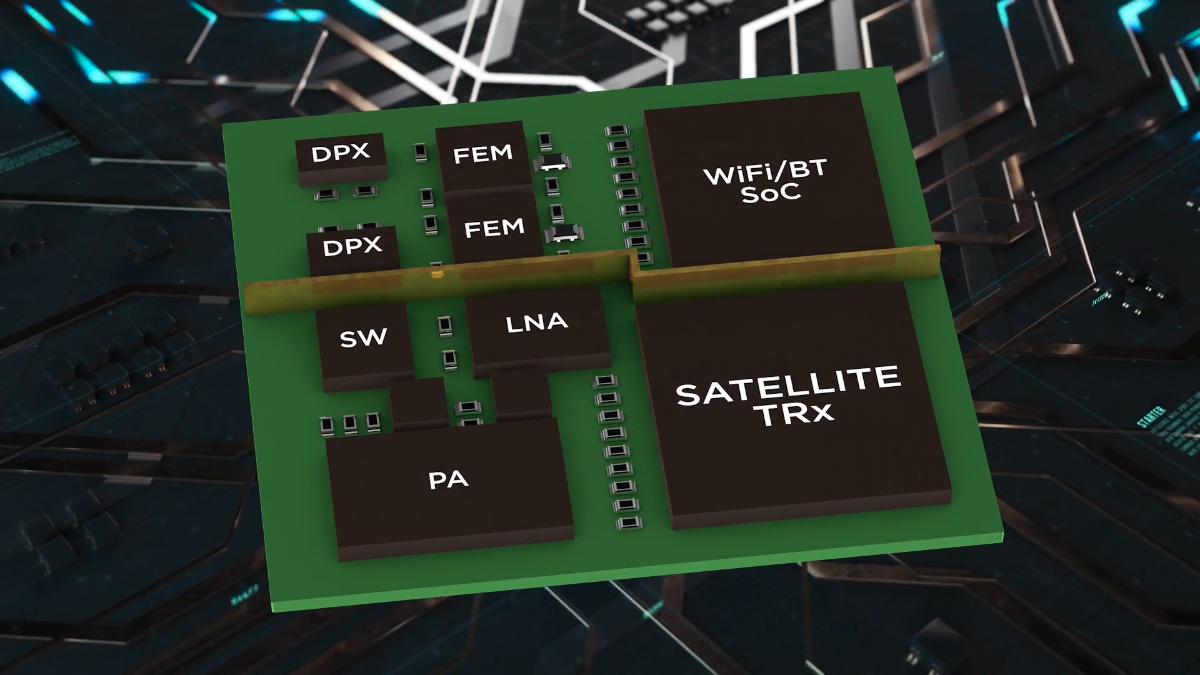
ASE delivers cost efficiencies by combining various satellite communications ICs into a single RF system-in-package module. Integration possibilities are expanding to enable:
- Emergency and Remote Communication
- Exploration of New Markets
- Global Coverage
- Seamless Switching

SiP Module
One SiP module integrates the satellite and Wi-Fi/Bluetooth front-ends.
ASE's highly innovative Satellite Communication System-in-Package (SiP) Module integrates the satellite transceiver front-end module with system-on-chip Wi-Fi/Bluetooth FEM components. It outputs to various satellite and Wi-Fi/BT antennas and can be further integrated with other antennas as needed. Integration can be achieved in one of three progressively space-saving packaging methods:
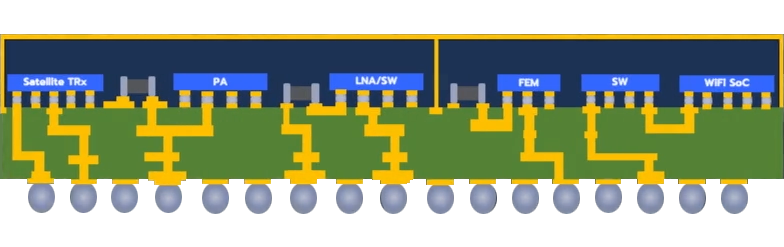
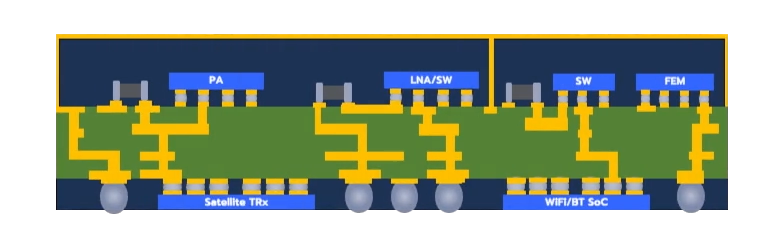

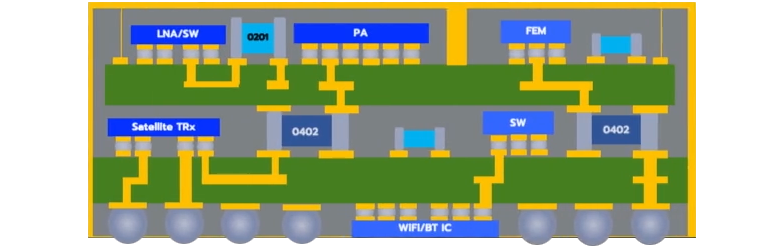
ASE plays a crucial role in mobile communications — from 2G, 3G and 4G to 5G and the potential integration of satellite communication into 6G. The module is presented to major customers as a cost- and space-efficient alternative, leading the pathway to future non-terrestrial communications market growth.