Sustainability

Green Manufacturing & Circular Economy

SDGs

United Nations Sustainable Development Goal 7United Nations Sustainable Development Goal 9United Nations Sustainable Development Goal 12United Nations Sustainable Development Goal 13

Overview

We design out waste and hazards across a product's whole life cycle.

As businesses continue to struggle with resource allocation and climate change, ASE is seeking to improve its value contribution through innovations that promote social and environmental benefits. We begin with the design and development of a product throughout its life cycle — raw material procurement, manufacturing, product use and final disposal. ASE strictly complies with global regulations and standards, and researches and develops solutions that enable lighter, thinner and more energy-efficient applications. Understanding the health impact of our solutions has led us to develop non-hazardous materials and to collaborate with suppliers on a sustainable supply chain.

2024Sustainable Supply Chain Award · Innovative Technology Award · ESG Sustainable Economic Activity Award
2023Circular Economy Award (CIER) — Outstanding ESG Contribution Award
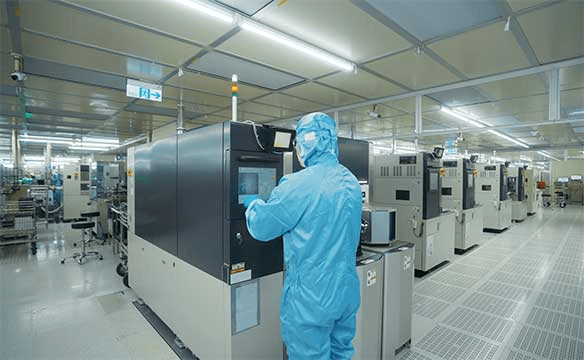
ASE cleanroom manufacturing operations

Hazardous substance management

We control and reduce the environmental impact of our products at the source.

In pursuit of highly sustainable manufacturing, we optimize our Green Product Management System (GPMS), maintain a substance database, and hold IECQ QC080000 certification with compliance to RoHS, REACH, Energy Star and the Energy-related Products Directive. Our Green Laboratory continuously evaluates and develops green materials, manufacturing methods and environment-friendly packaging.

Renewable energy

Renewable energy is central to ASE's move towards Net Zero.

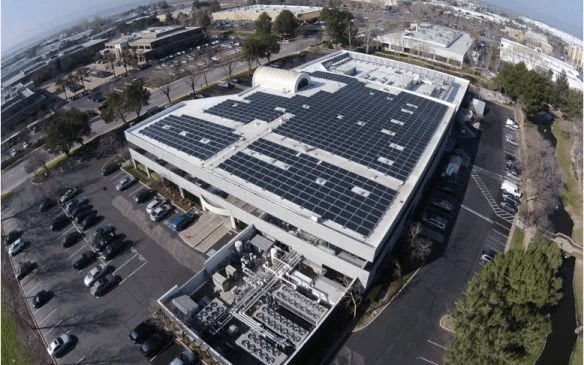
ASE continues to improve energy efficiency and adopt renewable energy alternatives across its operations. We currently have solar panels installed at facilities in Kaohsiung, Wuxi and California, and various ASE facilities acquire renewable energy certificates.

Solar panels at an ASE manufacturing site

The circular economy

Green Building Certification Standards

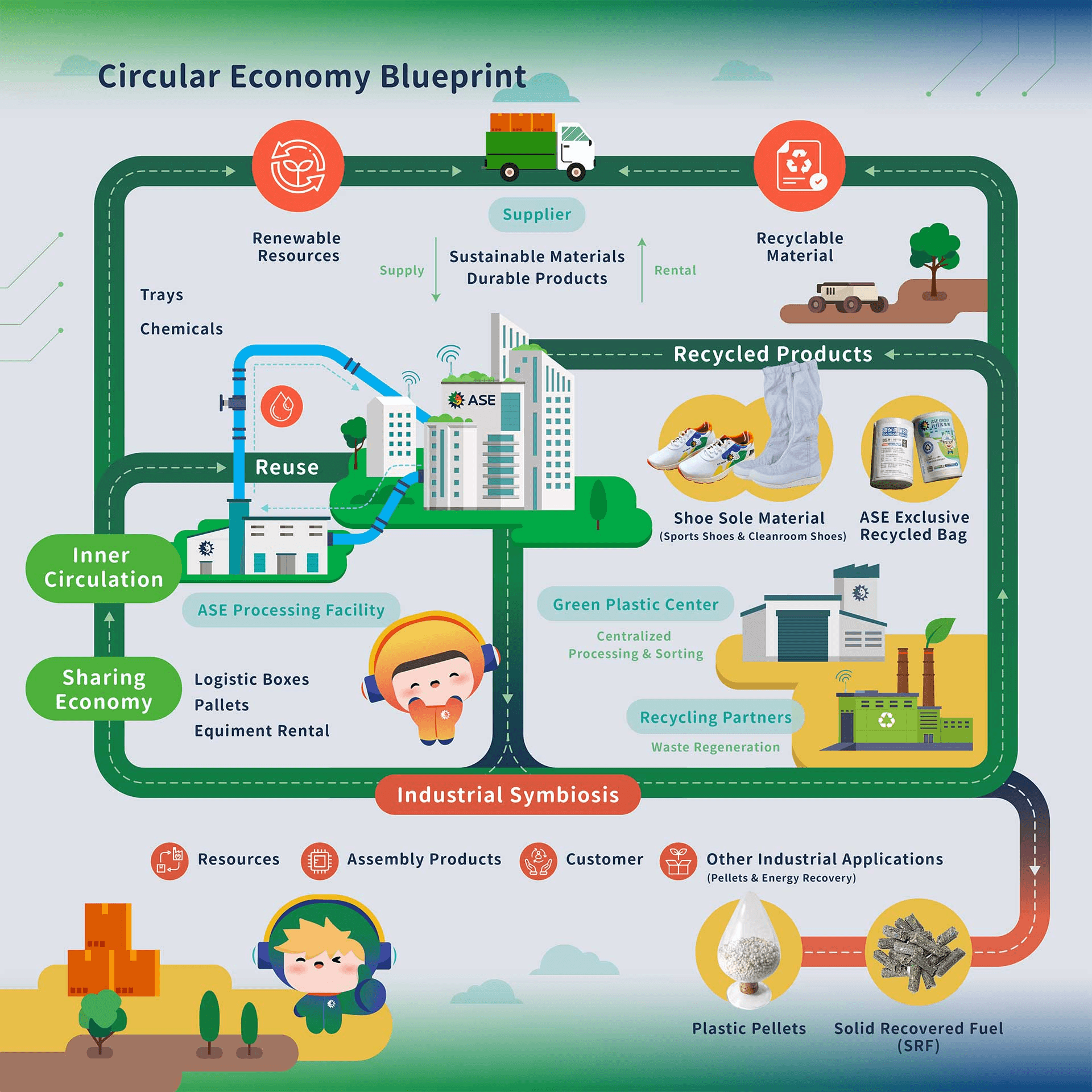
Promoting circularity is a key ESG tenet at ASE. Our waste and recycling management incorporates internal and external entities to achieve a circular economy — as illustrated by the four cases below.

ASE circular-economy blueprint
Circular-economy uses for waste molding compound
Case 1

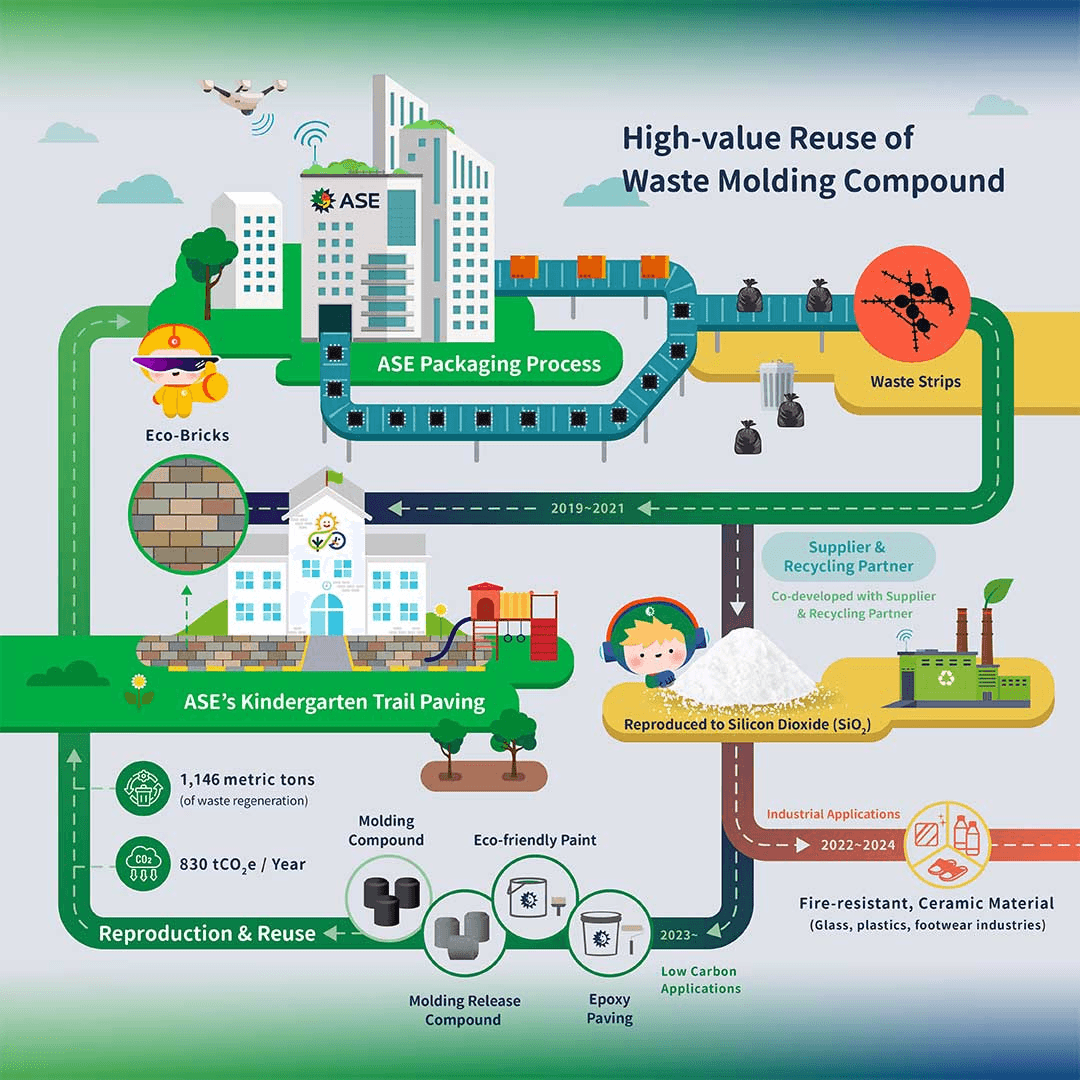
High-value Reuse of Waste Molding Compound

Around 1,100 tons of waste sealing strips are generated annually after product sealing. Containing a high concentration of silicon dioxide, the strips are non-toxic, hard, and heat-resistant. In collaboration with third-party suppliers, we developed eco-bricks from recycled strips for walkway paving at the ASE kindergarten in Kaohsiung. Since 2022, refined silicon dioxide has been applied in glass, footwear, and plastic industries, added to epoxy materials for new facility paving in 2023, incorporated into slippers in 2024, and used in eco-friendly coatings for the K27 restaurant in 2025. Through innovation, we transform waste into resources and promote a closed-loop circular economy.
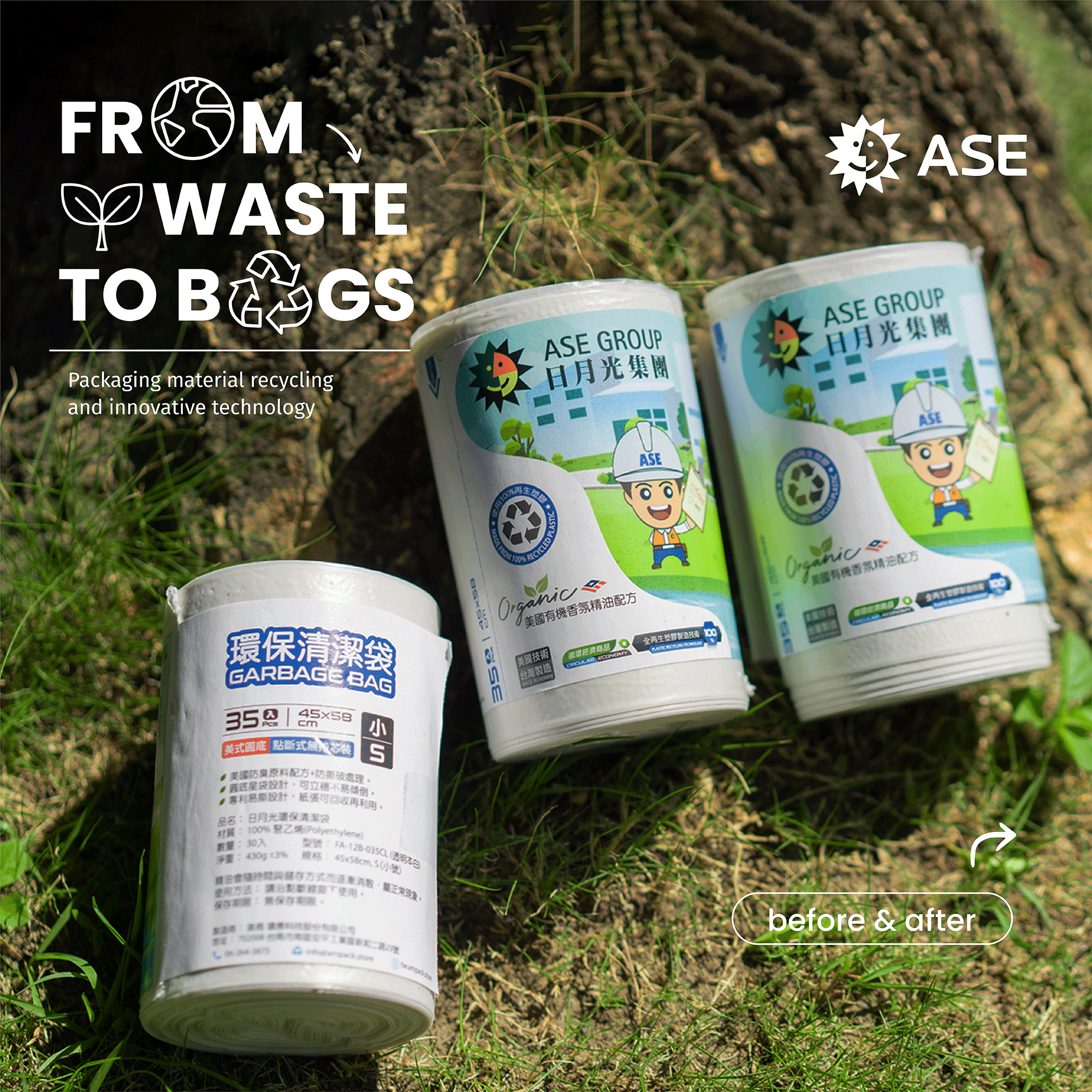
ASE recycled packaging material program
Case 2

Recycling Packaging Material

In the past, most packaging materials such as bubble wrap and foam were incinerated after use. ASE began working with recycling companies to collect the used materials and compress them into plastic pellets to be used into the manufacturing of consumer plastic bags. About 80,000 rolls of eco-friendly bags can be made every month.

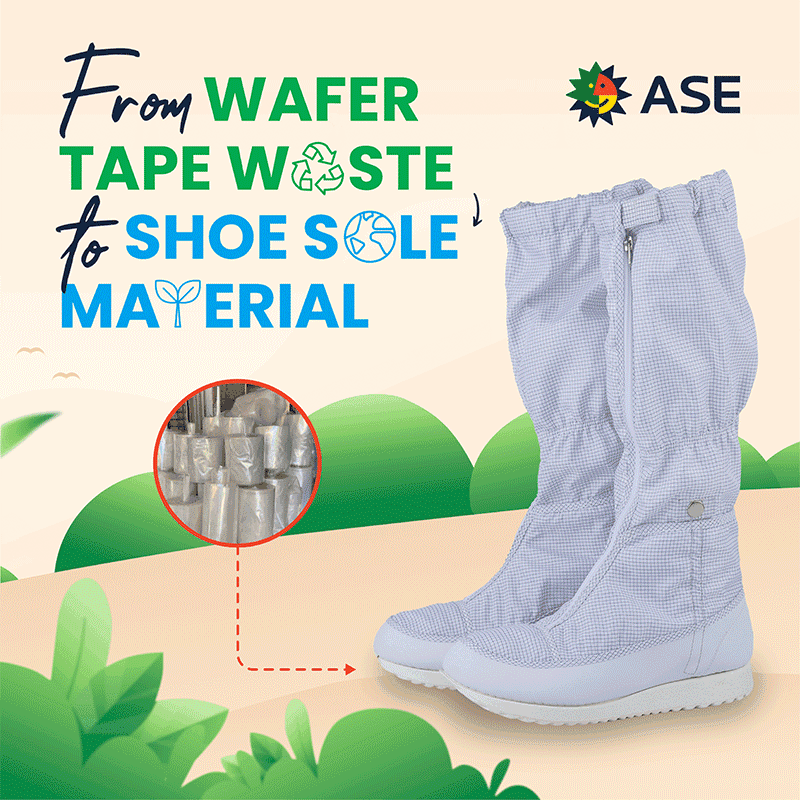
Wafer tape recycled into shoe sole material
Case 3

From Wafer Tape Waste to Shoe Sole Material

In semiconductor packaging processes, materials like “Dicing Tape” “Back Grinding Tape” and “UV Tape” are essential for protecting and supporting wafers. ASE uses over 200 tons of tape annually. Previously, waste tape was processed into “Solid Recovered Fuel (SRF)”- a more sustainable alternative to traditional incineration practices used in the industry. Now, we recycle it into Thermoplastic Polyolefin (TPO) for eco-friendly shoe soles. In 2025, we developed antistatic cleanroom soles for production line employees. More comfortable and durable, they help reduce the strain of long hours of standing and movement, creating a more worker-friendly environment. All recycling and shoemaking take place in Kaohsiung, cutting transport-related carbon emissions by 99% and truly reflecting the cradle-to-cradle concept of sustainability.

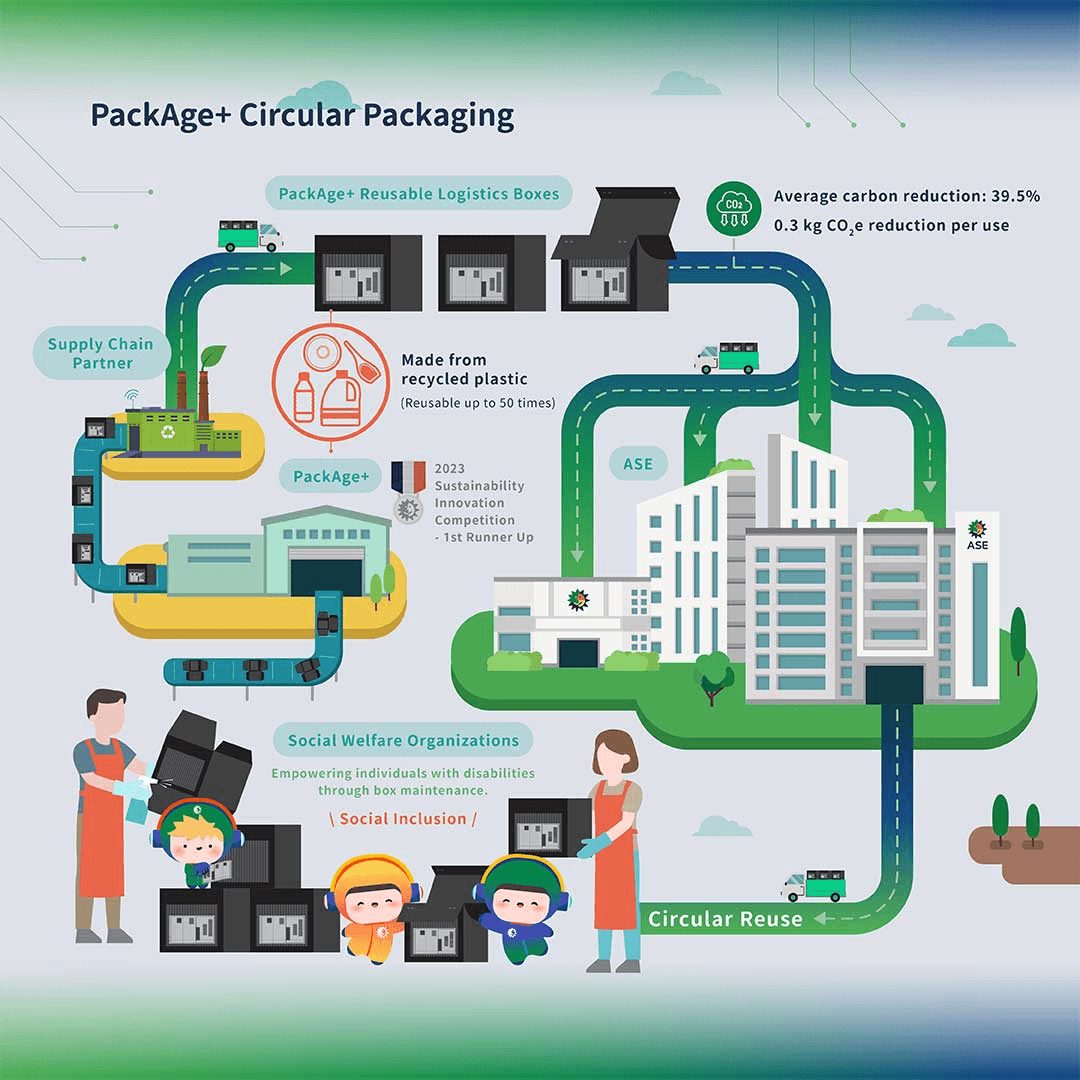
PackAge+ reusable logistics boxes circular-economy model
Case 4

PackAge+ Reusable Logistics Boxes

ASE promotes circular economy solutions across its operations, including the adoption of reusable logistics boxes developed by PackAge+. As the second-place winner of ASE’s 2023 Sustainability Innovation Competition, PackAge+ has since worked closely with ASE and its value chain partners to advance circular reuse practices. Made from recycled plastics and designed for up to 50 cycles of reuse, PackAge+ boxes help reduce single-use packaging. Each reuse lowers carbon emissions by about 39.5%, equivalent to approximately 0.3 kg of CO₂e, effectively cutting packaging waste and logistics-related carbon footprints. PackAge+ also partners with social welfare organizations to involve people with disabilities in the cleaning and sorting of reusable boxes—creating environmental impact while supporting social inclusion and community engagement.

More Green Actions

Green ActionsGreen BuildingGreen ActionsWater Reclamation

We use cookies to run this site and, with your consent, to measure how it is used. See our Cookie Policy and Privacy Policy.