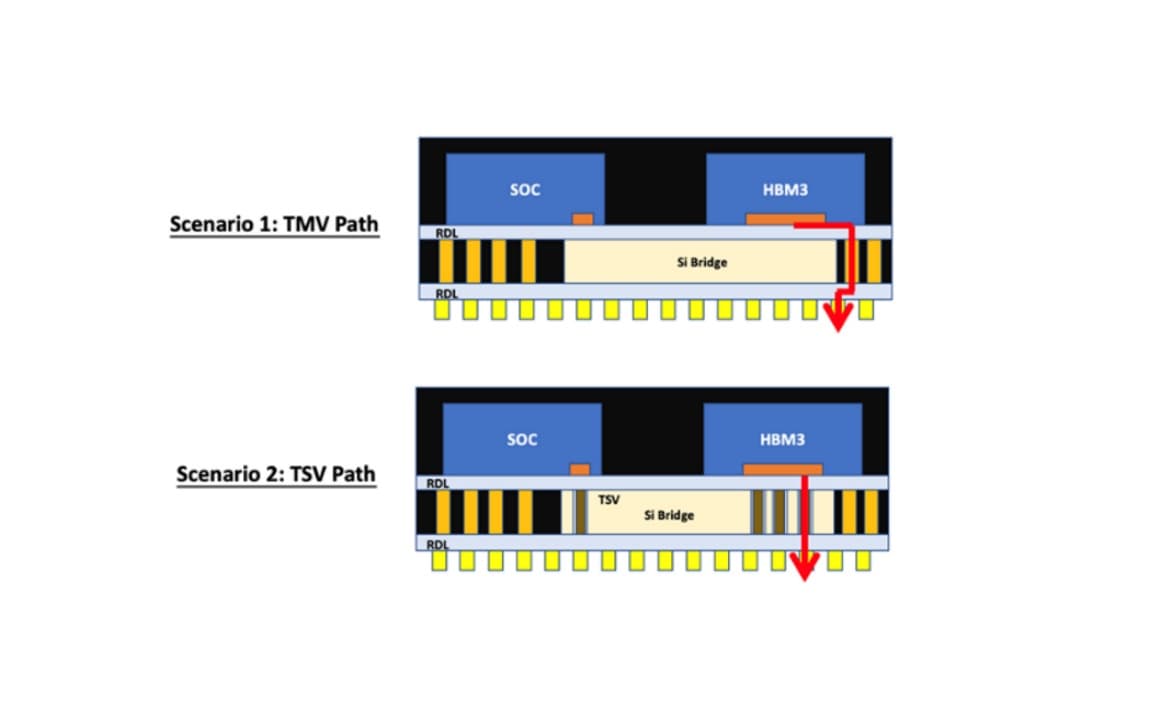
In the rapidly evolving fields of High-Performance Computing (HPC) and Artificial Intelligence (AI), the demand for higher bandwidth, greater I/O density, and improved thermal dissipation is increasing. To meet these challenges, we are proud to introduce “FOCoS-Bridge with TSV” as an advancement to ASE’s VIPack™ FOCoS-Bridge technology. This enhancement integrates a bridge die featuring a specialized Through Silicon Via (TSV) structure to provide better electrical performance and improved heat dissipation.
Mass Reflow vs Thermocompression Bonding
In our research, the FOCoS-Bridge with TSV test vehicle was built-up and it was composed of two identical fanout (FO) modules assembled on a single FCBGA (Flip Chip-Ball Grid Array) substrate in MCM (multi-chip-module) arrangement. Each of fanout module was integrated by 1 ASIC and 4 HBM3 with 4 TSV-bridge dies and 10 IPD (Integrated Passive Devices) dies. Total 14 dies were embedded within a FO module and the Fanout module size is ∼1.8x reticle size (∼1500 mm2). The package body size is 85 mm×85 mm.
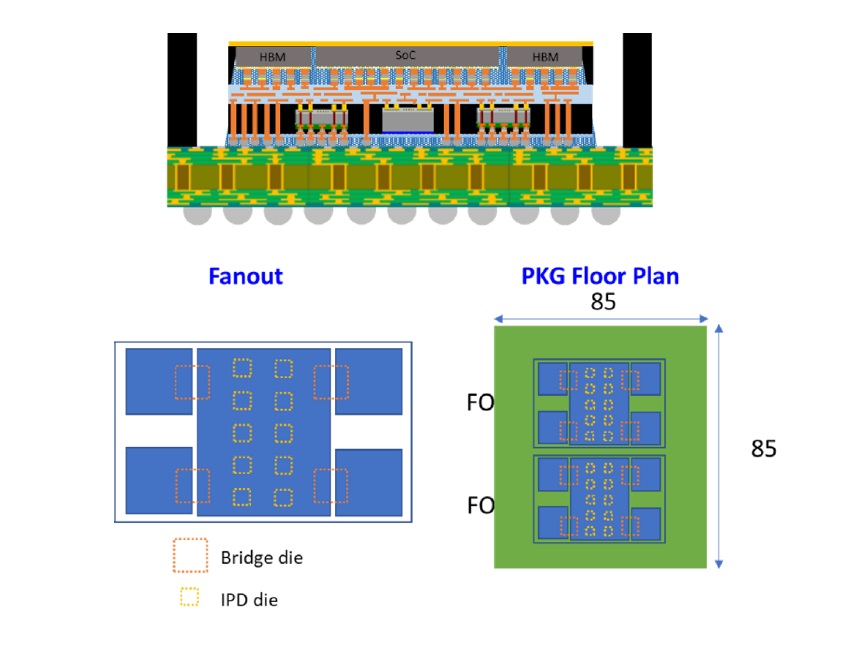
We conducted in-depth investigations into warpage behavior in large fan-out modules and the impact of various assembly techniques, including Mass Reflow (MR) and Thermocompression Bonding (TCB), on solder joint quality. The results demonstrated that TCB assembly effectively enabled the successful integration of FOCoS-Bridge with TSV and embedded IPD, achieving superior performance and reliability. This enhanced packaging solution addresses the evolving demands of next-generation HPC and AI applications and offering improved scalability and integration capabilities.
A Solution for the Future
FOCoS-Bridge with TSV is not just a technological upgrade; it is a scalable solution designed to meet the evolving demands of next-generation HPC, AI, and machine learning applications. By incorporating a specialized TSV structure within the bridge die, we have enhanced electrical performance and thermal dissipation, addressing key challenges in high-power and high-bandwidth systems.
Published in: 2025 IEEE 75th Electronic Components and Technology Conference (ECTC)