1760–1820 Industrial Revolution
Steam and water power replace hand production and bring the first machines.

Industry 4.0 is the fourth big leap in how things are made. Each earlier leap added a new source of power or intelligence to the factory; this one makes the factory connected and able to manage itself.
Steam and water power replace hand production and bring the first machines.
Electricity enables mass production, assembly lines and the division of labor.
Computers, electronics and the internet bring automation to the line.
Cyber-physical systems, IoT and robotization make factories self-managing. This is Industry 4.0.
A smart factory is the heart of Industry 4.0: a plant where machines, systems and people connect and share data, so the factory can watch itself and keep improving. It rests on a set of design principles, delivered by a handful of core technologies.
Machines, devices, sensors and people all connect and talk to each other.
Data is gathered at every point, so decisions are based on the full picture.
Systems help people decide, solve problems and handle unsafe tasks.

Cyber-physical systems can make routine decisions on their own.

Physical machines run and monitored by software.
AI that learns and improves over time.
Computing resources available whenever they are needed.

A network of machines constantly exchanging data.
$337.1B projected Industry 4.0 market by 2028 (up from $116.1B in 2021)
Source: Fortune Business Insights.A lights-out factory takes smart manufacturing to its limit: it runs entirely on its own. The name comes from the idea that you could switch off the lights and leave, and production would carry on with no one on the floor. In practice, that means three things:



In Japan, FANUC has run a lights-out factory for over 20 years, using robots to build other robots.
In the Netherlands, Philips makes electric razors on a lights-out line of 128 robots.
In the UK, online grocer Ocado fills orders from a warehouse run by about 3,000 robots.
In Taiwan, ASE uses fully automated factories to create, assemble and test semiconductor devices.
Going lights-out brings real gains, but each one comes with a matching challenge to solve first:
| Area | Opportunities | Challenges |
|---|---|---|
| Cost | Savings on material, inventory, management. | Upfront machines, line setup, early issues. |
| Efficiency | Faster, more accurate via trained machines. | Major changeovers still need humans. |
| Scale | Uninterrupted operation for days/weeks. | Needs large volumes + customization. |
| Staff | Upskilled, safer, better wages. | Skilled workers, continuously trained. |
The shift is already showing up in the numbers:
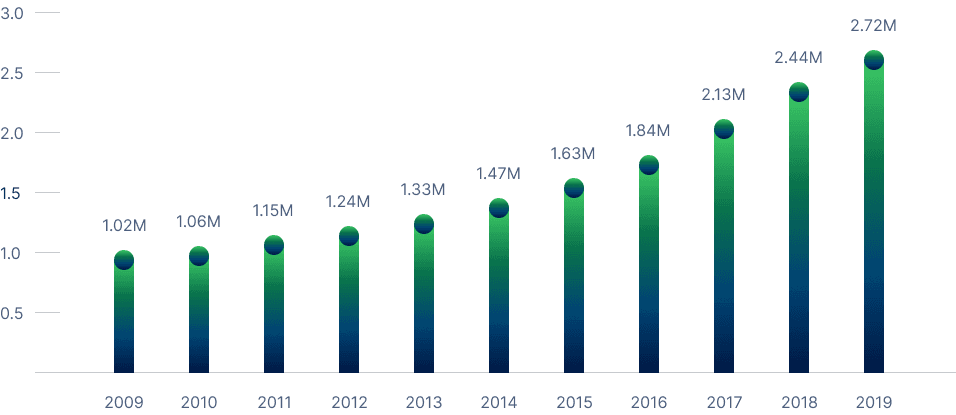
1.02M (2009) → 2.72M (2019). IFR.
Source: International Federation of Robotics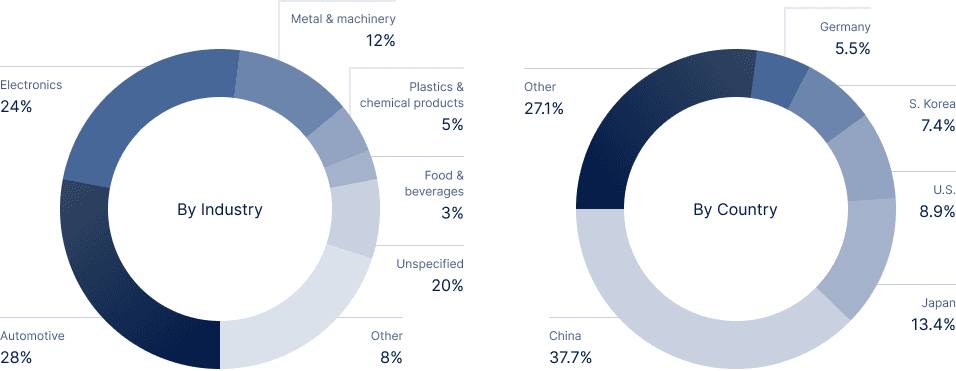
By industry: Automotive 28%, Electronics 24%, Metal & machinery 12%, and others. By country: China 37.7%, Japan 13.4%, U.S. 8.9%, S. Korea 7.4%, Germany 5.5%.
Source: International Federation of Robotics (IFR).
3% human-driven, manual only · 17% completely digital, lights-out · 79% human-driven, augmented with digital.
Source: Gartner.ASE sits in the semiconductor supply chain and runs some of the industry's earliest lights-out factories.